

Revisit known compounds.
Investigate mechanisms and cognitive hypotheses beyond a compound’s familiar use. Build a stronger starting point for repurposing research.
01 / Compound intelligence
Neurolab assembles a structured forecast spanning mechanisms, brain systems, and cognition.
{"compound_query": "ketamine","canonical_smiles":"CNC1(CCCCC1=O)C2=CC=CC=C2Cl","inference_route":"multi_head_graph_neural_network","kg_entity_id": 1227,"kg_support": {"nodes": 98, "edges": 109},"kg_version": "v43.262","status": "resolved"}COMPOUND → INFERENCE → REPORTKetamine / application capture
Find the signals that matter to your research questions.
Investigate receptor relationships and candidate mechanisms of action.
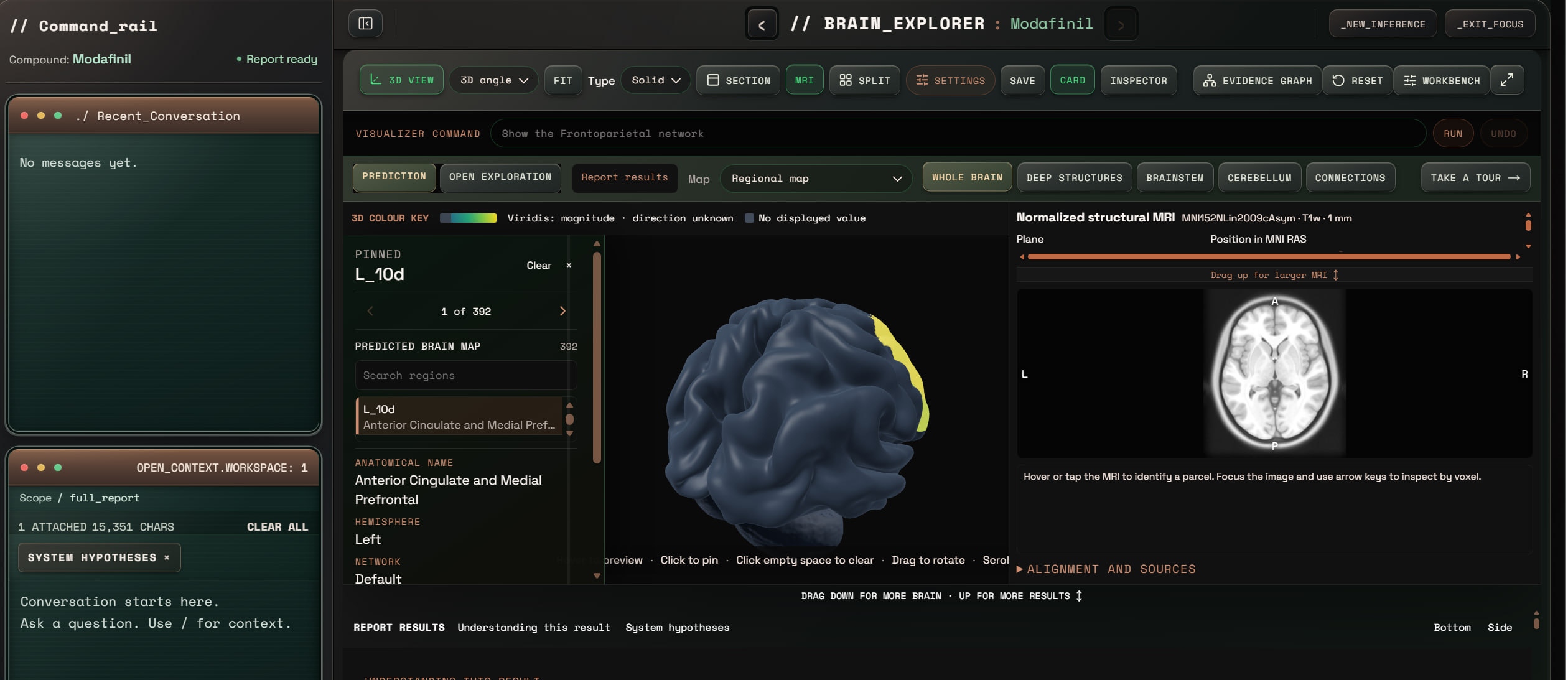
Explore outputs across circuits, regions and networks.
Examine predicted cognitive effects and the context behind them.
02 / An explorable research workspace
Read it. Question it. Visualize it. Take it into your next analysis. Neurolab puts the results within reach of both researchers and machines.
01 / Structured outputs
Open individual sections. Inspect nested outputs. Attach a finding to a question, or export the data and keep investigating.
Human-readable. Machine-readable. Exportable.03 / A new dimension for discovery
Brain effects can matter even when the brain wasn’t the original target. Bring another line of investigation into the compounds you already study—and the ones you haven’t explored yet.
Investigate mechanisms and cognitive hypotheses beyond a compound’s familiar use. Build a stronger starting point for repurposing research.
Start with a molecular structure. Examine its forecasted profile and develop questions for your next experiment.
Bring potential brain effects into candidate discussions alongside on-target activity and the data your team already uses.
More questions worth asking.
More directions worth exploring.
04 / The science underneath
Graph neural networks and deep learning work alongside chemical-structure retrieval and mechanism reasoning. A versioned knowledge graph connects the biological context.
Neurolab knowledge graph · v43.262
Enter a known compound name or provide a molecular structure as SMILES.
Known compounds follow the graph-model route. New structures follow a dedicated chemistry and mechanism workflow.
Explore a structured report with predictions, available evidence, source context and model metadata. Export what you need.